2026-08-20
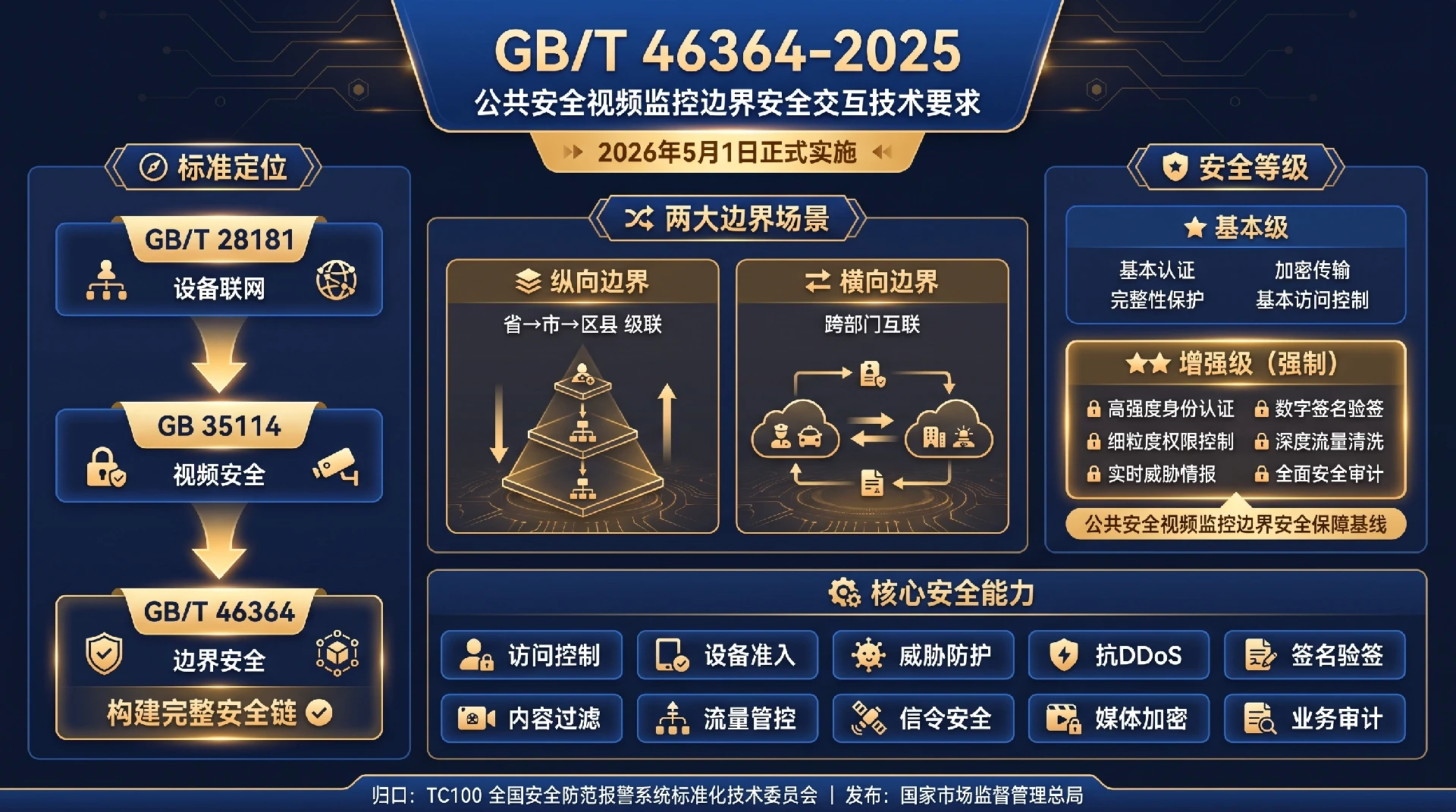
Policy Interpretation of GB/T 46364-2025 "Technical Requirements for Boundary Security Interaction of Public Safety Video Surveillance"
Release: October 5, 2025 | Implementation: May 1, 2026 | Centralized by: National Technical Committee for Standardization of Security and Alarm Systems (TC100)
1、 Standard positioning
This is one of the 15 national standards for public safety video images that will be officially implemented from May 1, 2026, specifically addressing a core issue: how to maintain border security when video surveillance systems are interconnected across networks and levels.
It forms a complete vertical system with GB/T 28181 (Device Networking) and GB 35114 (Video Information Security)——
Standard
problems solved
GB/T 28181
How can video devices be connected
GB 35114
How to 'defend' video data
GB/T 46364
How to 'live securely' cross network data exchange
2、 Two types of boundary scenes
The standard proposes architecture requirements for two types of interconnected scenarios:
Vertical boundary (cascading upper and lower levels)
Vertical integration of video platforms from province to city to district/county
The superior platform retrieves information from the subordinate, and the subordinate submits it to the superior
Horizontal boundary (same level across departments)
Video sharing between departments such as public security, urban management, transportation, and emergency response
Horizontal interconnection must comply with the GB/T 28181 protocol
3、 Security level: Basic level vs Enhanced level
The standard divides the boundary security interaction system into two levels:
Basic level - Suitable for ordinary video image sharing and exchange enhancement level - Suitable for video image sharing and exchange platforms containing sensitive information (mandatory requirement)
Enhanced levels have stricter requirements for the following security capabilities:
Two way identity authentication
Signal encryption and integrity verification
Video stream encryption
Fine grained access control
4、 Core security capability requirements
The standard requires the boundary security interaction system to have the following security capabilities (with stricter enhancement levels):
capability item
Instructions
access control
Fine grained authorization based on identity and attributes
Equipment access control
Unauthorized devices are prohibited from accessing the network
Unified threat protection
Prevent vulnerability exploitation and injection attacks
Anti DDoS
Border anti attack capability
Signature verification
Assurance of Signal Authenticity and Integrity
Content filtering
Illegal video content recognition and filtering
Traffic control
Bandwidth control and abnormal traffic detection
Service Authentication
Two way authentication between platforms
Signaling Security
SIP and other signaling protocol encryption
Media stream security
RTSP/RTP and other video stream encryption
Business Audit
Full operation log retention
centralized monitoring
Real time monitoring of border security situation
Cascade management
Vertical cascading safety control
5、 Direct association with DeepShield products
The safety capability specified in GB/T 46364-2025 corresponds to the height of the Deep Shield product line:
TSA/VBSP/NACP → Device Admission Control, Access Control
VDSP → Content Filtering, Video Data Security
VDP → Data Encryption and Transmission Security
VISA/DSA → Business Audit, Log Retention
VOPS → Centralized monitoring, border security situational awareness
6、 Market impact
Starting from May 1, 2026, newly built video sharing and exchange platforms must meet the requirements of this standard in order to pass acceptance
Enhanced level requirements will promote the comprehensive implementation of national secret algorithms in the field of video boundaries
For video projects involving cross network and cross cascading, the boundary security interaction system will become a mandatory procurement item