2026-10-28

当“智慧政务”成为基层治理的新常态,政务大厅、服务窗口、自助终端上的摄像头正以前所未有的密度采集着人脸、证照与办事影像。我们享受着“刷脸即办”的便捷,却往往忽略了一个隐忧:这些承载个人敏感信息的视频数据,在采集之后,究竟被如何存储、如何流转、又被谁调取?一段办事大厅的人脸视频,从摄像头到后台存储,再到跨部门协查调阅,路径越长,失控的风险越高。近年来,多起因内部人员违规调取、拷贝监控视频引发的公共事件屡见报端,一次次敲响警钟——政务视频,正在成为隐私泄露与合规风险的高危地带。
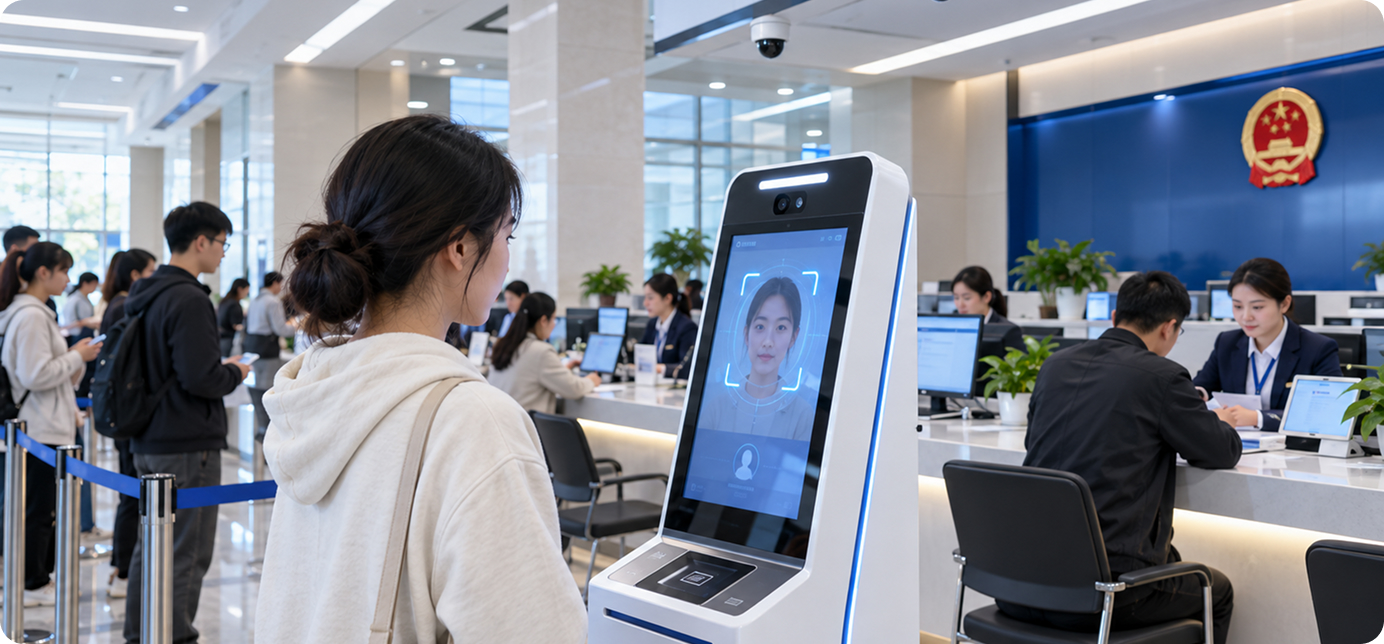
采集端“裸奔”:办事大厅、出入境窗口、信访接待等场景的人脸与影像数据高度敏感,但多数系统重采集、轻防护,视频明文存储、明文传输,一旦流出便无法溯源定位。
调阅端“无界”:跨部门、跨层级调取视频缺乏统一的权限与审批机制,谁都能看、谁都能下,无审计、无追溯。数据脱离政务专网后,使用单位不再受约束,泄密责任最终仍由数据源提供方——也就是政务部门自己来承担,陷入被动“背锅”困局。
合规端“失守”:《数据安全法》明确要求对数据实行全生命周期安全管控;《个人信息保护法》将视频中的人脸归入生物识别类敏感个人信息,第五十一条要求处理者采取加密、去标识化等安全技术措施并合理确定操作权限。粗放管理的代价,正在从舆情风险升级为法律责任。
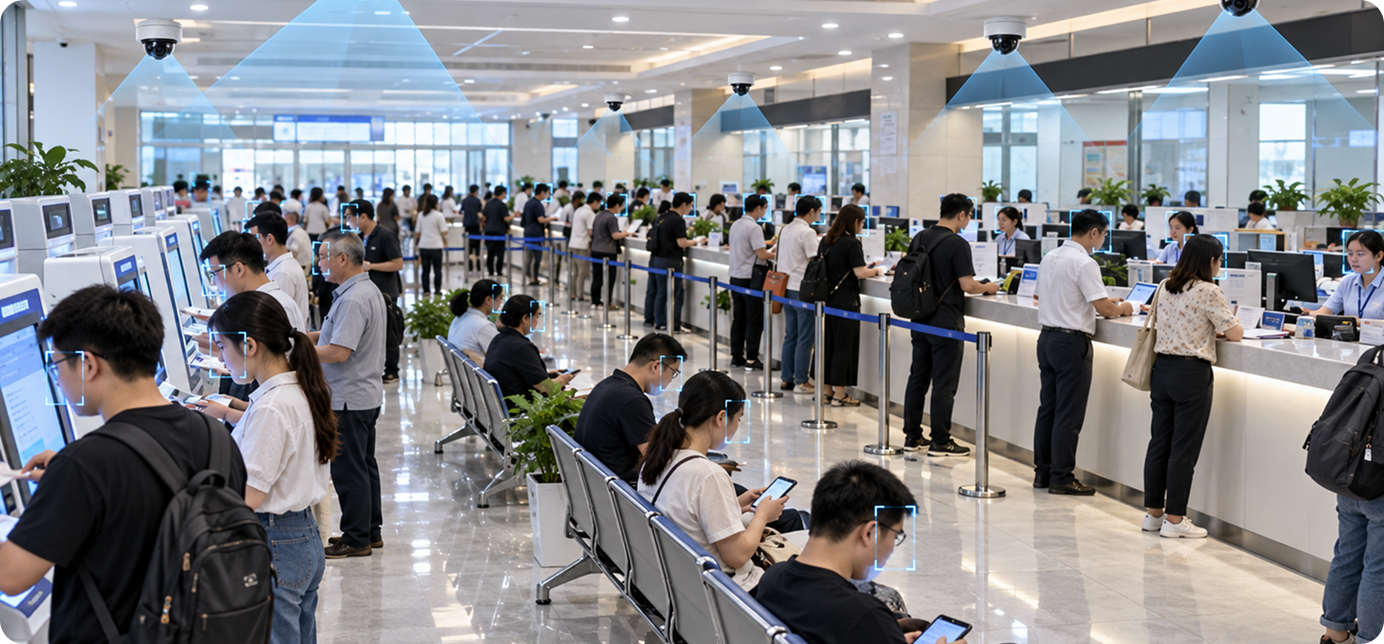
敏感数据识别与动态脱敏。政务体系除视频外,还沉淀着证照、身份信息与办事材料。基于AI 深度识别引擎智能识别敏感数据,按预设规则完成分级分类打标,并提供动态脱敏,让非必要场景只拿到处理后的结果。
视频数据导出权限可控:对视频数据导出与外发设置严格的使用权限,包括使用次数、有效时限、密码验证,并严格执行线上审批流程,审批通过才能导出,导出即带水印、即受约束,从源头阻断“随意下载、随意传播”。
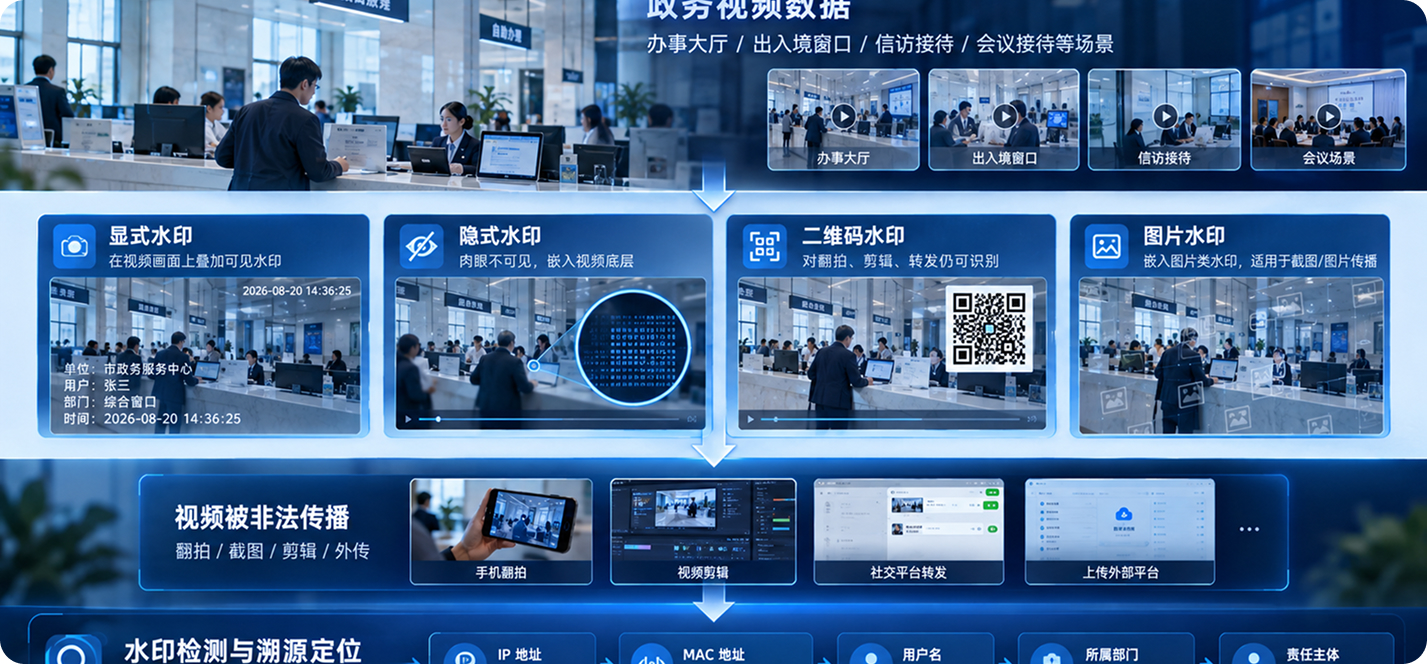
水印溯源:在线浏览视频与图像时,屏幕叠加包含IP、MAC、用户名、部门等信息的显性水印,对偷拍偷录形成强震慑;同时支持肉眼不可见的隐式水印与可扫码识别的二维码水印,即便视频被翻拍、剪辑、转发,仍能快速定位泄露源头,落实“谁使用、谁负责”。
视域数据的核心能力
视频数据安全防护系统以事前预防、事中审计、事后追溯的设计理念,针对现实场景中存在的泄密风险提供了一套具有针对性的解决方案。核心能力可概括为四个方面:
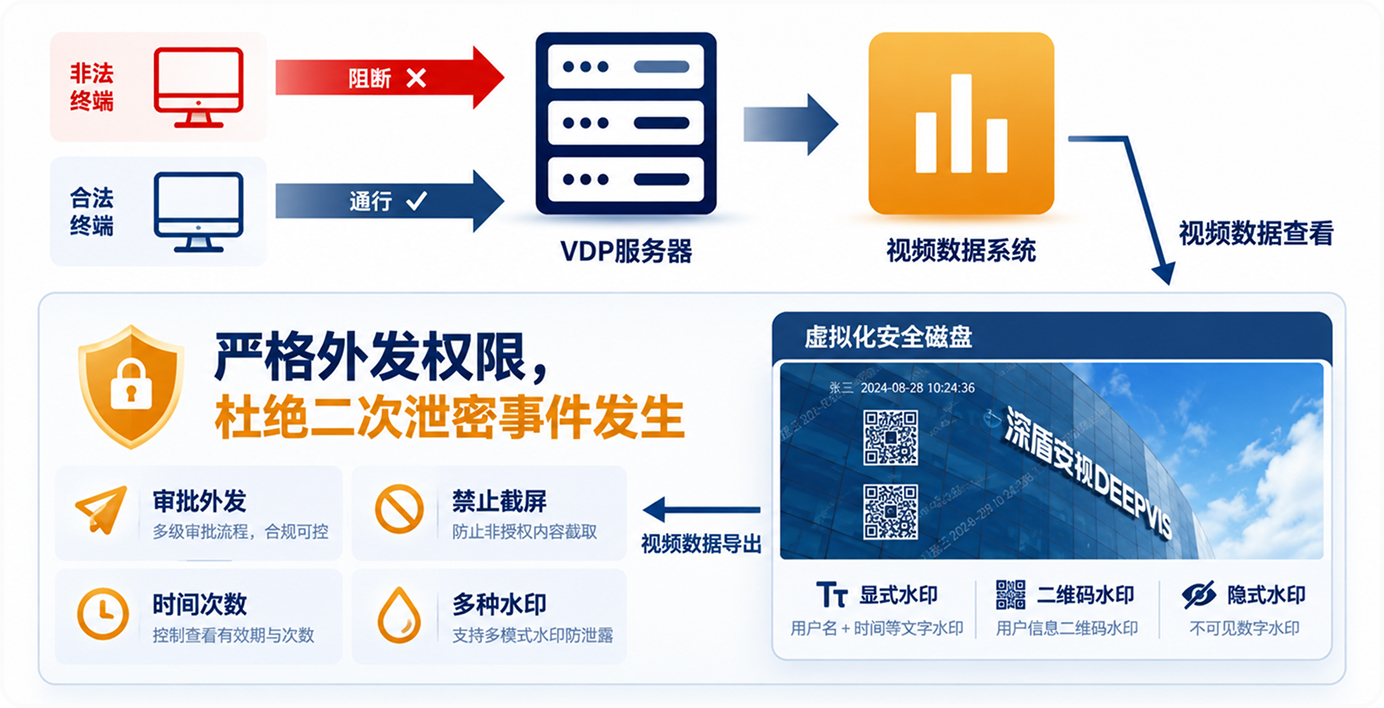
访问控制:集成准入控制系统,仅允许合法的终端访问视频数据,从网络层面保障视频数据安全。
本地防护:一方面利用屏幕水印技术对视频进行水印覆盖,从而对视频拍摄行为进行溯源及追责处理;另一方面通过驱动级文件重定向技术,将从视频管理平台下载到本地的视频数据强制重定向到虚拟安全磁盘,防止通过非法手段将视频数据拷贝带离终端。
离境管控:对外交互数据设置使用权限并添加水印,防止二次泄密,支持自主外发与审批外发双模式。
审计报表:提供全面的视频数据审计报表信息,自动记录操作时间、操作人、部门、审批人、视频数据信息、计算机IP和MAC信息等,让数据流转全程可见、可查、可追溯。
结合AI大模型的行为预测与数据防泄漏技术,有效防范网络入侵、拍照、外发、拷贝等泄密事件。设备旁路部署,不改变既有网络架构,兼容GB-28181等国家标准与主流视频平台,实现“一套系统,守护政务视域空间”。
合规收益:把红线变成底气
对政务部门而言,部署视域数据安全流转管控方案,核心价值在于把法律要求转化为可落地的技术能力。视频中的人脸属《个人信息保护法》第二十八条列举的生物识别类敏感个人信息,第二十六条要求的“不得用于其他目的”,对应审批前置的外发管控,以打开密码、使用次数、有效时限、接收终端锁定用途;第二十八条要求的“严格保护措施”,对应虚拟安全磁盘的隔离存储;第五十一条第(三)项要求的“加密、去标识化等安全技术措施”,对应VDSP的敏感数据自动发现、智能分类分级与动态脱敏。
其余条款同样落在具体手段上:第五十一条要求的分类管理与操作权限,对应终端准入与四类水印防护;第五十五、五十六条要求的“对处理情况进行记录”,对应日志分析与调用审计报表;第五十七条要求的泄露后补救与通知,对应水印溯源与审计日志对泄露源的快速还原。技术措施与法律条款一一对应,迎检有据、定责有依。
在此基础上,方案带来三重收益:
一是隐私保护:敏感视频“不失控、不泄露”,守住公民个人信息底线。
二是责任厘清:每次调阅、下载、外发有迹可循,水印溯源可还原泄露源头,告别被动担责。
三是合规达标:契合《数据安全法》《个人信息保护法》《网络数据安全管理条例》等要求,筑牢安全基底。
结语
视频数据安全不是“锦上添花”,而是智慧政务不可逾越的合规底线。当摄像头越来越密,唯有让每一帧视频“有权限才能看、有审批才能下、泄露后能溯源”,才能切实守护好群众的那张“脸”。
As smart government services become the new normal for grassroots governance, cameras in government service halls, service windows and self-service terminals are collecting facial data, certificates and service images at an unprecedented density. While enjoying the convenience of identity verification via facial recognition, we often overlook a hidden risk: after collection, how are these video datasets carrying sensitive personal information stored, transmitted and accessed?For a facial video captured in a service hall, the longer its transmission path from cameras to back-end storage and further for cross-departmental collaborative review, the higher the risk of out-of-control data. In recent years, multiple public incidents caused by internal staff illegally accessing and copying surveillance videos have been widely reported, sounding repeated alarms: government video data has become a high-risk area for privacy leakage and non-compliance.
Unprotected collection endpoint: Facial and image data from service halls, entry-exit windows and petition reception scenarios are highly sensitive. Nevertheless, most systems prioritize data collection over protection, storing and transmitting videos in plaintext. Once leaked, such data cannot be traced.
Unrestricted access endpoint: There is no unified permission and approval mechanism for cross-department and cross-level video retrieval. Videos can be viewed and downloaded arbitrarily without audit or traceability. After data leaves the government private network, users are no longer restrained. Ultimately, the government department providing the data source has to bear the leakage responsibility passively.
Compliance failure: The Data Security Law explicitly mandates full-lifecycle security control over data. The Personal Information Protection Law classifies facial data in videos as biometric sensitive personal information. Its Article 51 requires processors to adopt security technical measures such as encryption and de-identification, and reasonably define operation permissions. The cost of extensive and loose management is escalating from public opinion risks to legal liabilities.
Sensitive data identification and dynamic desensitization. In addition to videos, government systems accumulate certificates, identity information and service documents. Powered by an in-depth AI recognition engine, the system intelligently identifies sensitive data, labels data by grading and classification according to preset rules, and implements dynamic desensitization, so that only processed results are available for non-essential scenarios.
Controllable permissions for video export: Strict usage restrictions are configured for video export and outbound distribution, including usage counts, validity periods and password verification. An online approval workflow is enforced; export is permitted only after approval. Exported videos carry watermarks and usage constraints immediately to block unauthorized downloading and dissemination at the source.
Watermark tracing: Visible watermarks embedded with IP address, MAC address, username, department and other information are overlaid on screens during online preview to deter secret photographing and recording. Invisible digital watermarks and scannable QR code watermarks are also supported. Even if videos are re-shot, edited or forwarded, the leakage source can be quickly located to implement the accountability principle of “user takes responsibility”.
CORE CAPABILITIES OF VISION DATA SECURITY SYSTEM
Adopting the design concept of pre-incident prevention, in-process audit and post-incident tracing, the video data security protection system delivers a targeted solution against leakage risks in real scenarios. Its core capabilities fall into four categories:
Access control: Integrated with an access control system, it allows only legitimate terminals to access video data and protects video security at the network layer.
Local endpoint protection: On one hand, screen watermarking is applied for tracing and accountability against unauthorized filming. On the other hand, driver-level file redirection forces videos downloaded from the video management platform to be saved onto a virtual secure disk, preventing illegal copying and exfiltration from terminals.
Outbound data control: Usage permissions and watermarks are applied for externally shared data to prevent secondary leakage. Both self-initiated outbound transmission and approval-based outbound transmission modes are supported.
Audit reports: Comprehensive audit reports for video data are provided. The system automatically logs operation time, operator, department, approver, video information, terminal IP and MAC address, making the entire data flow visible, queryable and traceable.
Combined with LLM-based behavior prediction and data leakage prevention technologies, it effectively guards against network intrusion, unauthorized photographing, outbound transmission and copying. Deployed in bypass mode without modifying existing network architecture, it is compatible with national standards such as GB-28181 and mainstream video platforms. One single system secures the whole government vision space.
COMPLIANCE BENEFITS: TURN COMPLIANCE RED LINES INTO RELIABLE CAPABILITIES
For government departments, the core value of deploying the vision data secure flow control solution lies in translating legal requirements into implementable technical capabilities. Facial data in videos is biometric sensitive personal information listed in Article 28 of the Personal Information Protection Law. The requirement under Article 26 that such data “shall not be used for other purposes” is realized via pre-approval outbound control, where access password, usage count, validity period and receiving terminals lock the usage scope. The “stringent protective measures” required by Article 28 correspond to isolated storage on virtual secure disks. The security technical measures including encryption and de-identification specified in Article 51 (3) match VDSP’s automatic sensitive data discovery, intelligent classification & grading and dynamic desensitization.
Other provisions are also mapped to concrete controls: classified management and operation permissions required by Article 51 correspond to terminal access control and four types of watermark protection; the requirement to record data processing activities under Article 55 and Article 56 is fulfilled by log analysis and access audit reports; post-leakage remediation and notification required by Article 57 are supported by watermark tracing and rapid leakage source reconstruction from audit logs. Technical measures align one-to-one with legal clauses to provide valid evidence for inspection and accountability.
On this basis, the solution delivers three major benefits:
First, privacy protection: sensitive videos stay under control without leakage to safeguard citizens’ personal information.
Second, clear accountability: every access, download and outbound transmission leaves traces. Watermark tracing can restore leakage sources to avoid passive liability.
Third, compliance fulfillment: it meets requirements of the Data Security Law, Personal Information Protection Law, Cyberspace Data Security Management Regulations and other rules to consolidate the security foundation.
CONCLUSION
Video data security is not an optional extra, but an unbreakable compliance bottom line for smart government. As surveillance cameras proliferate, only when every video frame follows the rule of “viewable with permission, downloadable with approval, traceable after leakage” can we effectively protect citizens’ facial biometric information.